Sound familiar?Bognor
- The call
- The door works well, although the open panels sit far beneath a sloped or raised ceiling. You are exploring whether the track, counterbalance and operator can be redesigned to follow the room more closely.
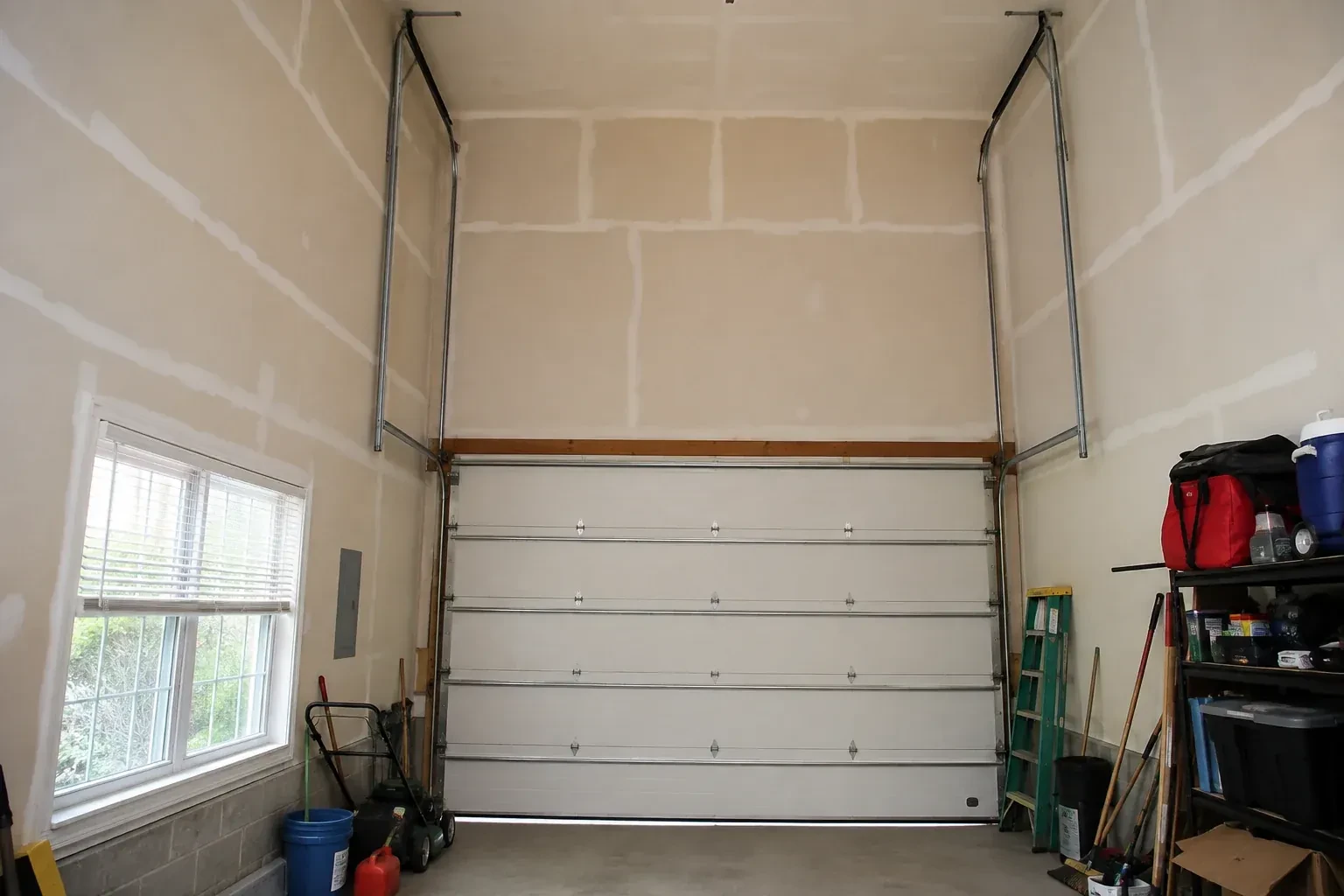
High lift sits between standard lift and full vertical lift. The door first travels upward along extended vertical tracks, then follows a curved transition and finishes horizontally. That makes it useful where the ceiling is higher than the opening but there is still room behind the door for horizontal panels. The available dimension is shaped by ceiling obstructions, spring and shaft space, track radius, door height and service access. A site assessment turns those limits into a practical clearance figure before parts are specified.
Sound familiar?Bognor
High-Lift Garage Door Conversion · Bognor
Scene 1
The existing springs are not judged by appearance alone. Door weight, added vertical travel, drum geometry, cable path, shaft length and desired cycle characteristics all shape the new counterbalance specification. The technician records spring tags where present, shaft diameter, bearing locations, drum type and cable condition, then uses the proposed layout to calculate the replacement set. This system review is what lets the door feel controlled from floor to open position, even though the panels now follow a substantially different route.
Scene 2
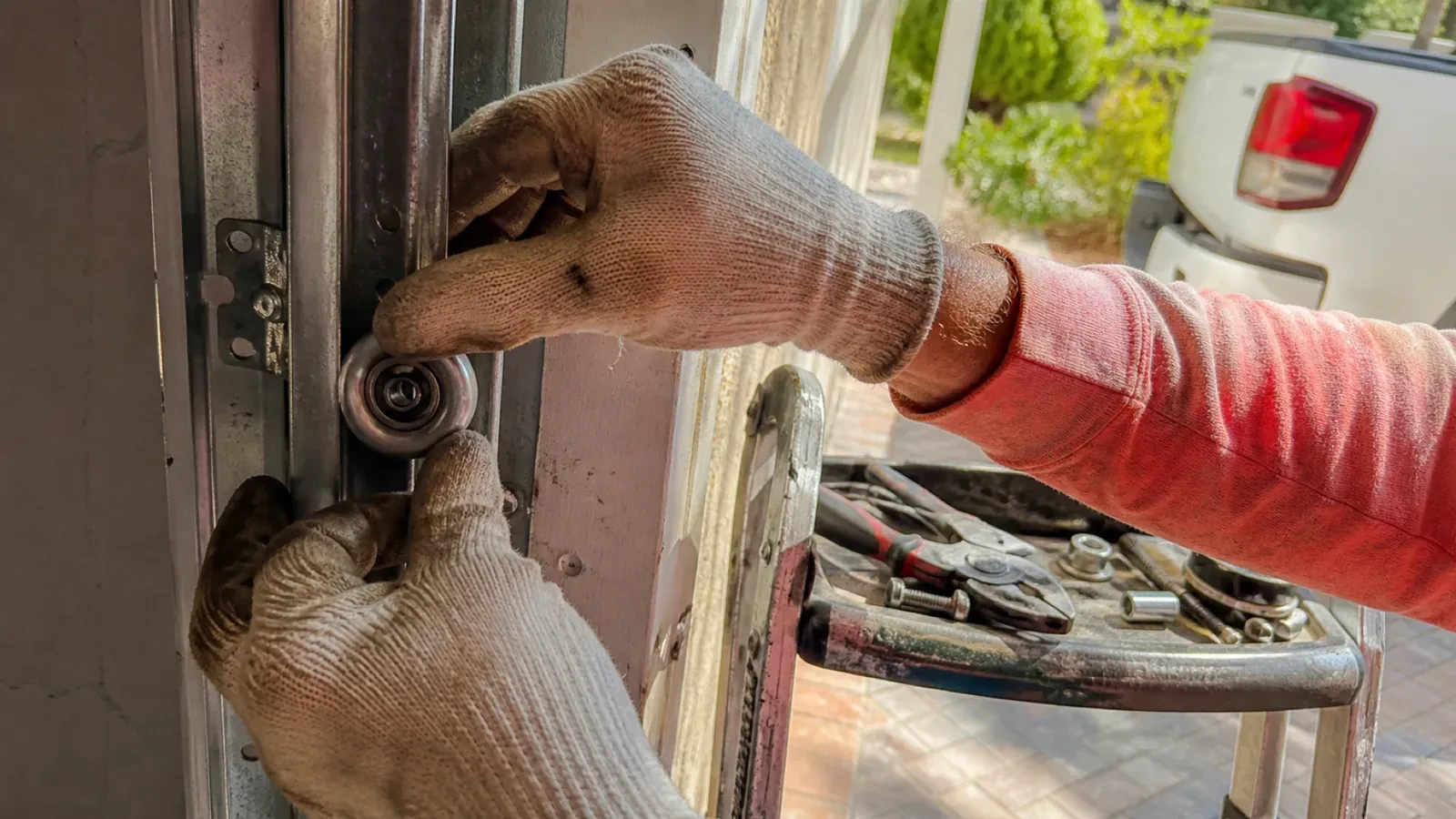
New vertical track is positioned plumb on both sides of the opening and spaced for smooth roller travel. The track rises to the calculated high-lift point, where matched transition sections guide the top panel toward the ceiling. Jamb brackets, flag brackets and reinforcing angles are placed according to the layout and suitable attachment points. Technicians compare both sides as they work so elevations, spacing and curves remain symmetrical. Accurate track geometry gives the sections a clean route and provides the foundation for cable and spring setup.
Scene 3
You receive a demonstration of powered operation and the intended manual-release function. With the operator disengaged under the proper conditions, the converted door should feel controlled rather than depending on the motor to overcome its weight. The technician explains what normal movement sounds and looks like, including even cables and a level bottom edge. Knowing that baseline makes future changes easier to notice. The opener is then re-engaged, and its limits and applicable protective functions are shown during a complete closing and opening cycle.
What shapes the quoteSaugeen Door Specialists
FeesSame any hour
High lift describes a sectional-door arrangement that travels vertically above the opening for an added distance before curving into horizontal track. The dimension from the header to the underside of that raised track is the high-lift distance. It uses more wall height than standard lift while still storing the open panels overhead.
It is practical when an existing sectional opening has meaningful wall height above it, enough ceiling depth for the horizontal run, suitable support conditions and a clear reason for gaining overhead room. The door, counterbalance and operator must be designed together. A measured feasibility plan confirms the usable clearance before installation becomes the next step.
A high-lift door changes how cable must wind as the panels move vertically and then turn. High-lift drums use a contoured groove profile to manage that changing leverage and help balance the door through its travel. Drum selection is coordinated with door weight, lift dimension, cable length, shaft and spring design rather than chosen as an isolated hardware swap.
GreyOntario
High-Lift Garage Door Conversion · Owen Sound, Chatsworth, Georgian Bluffs, Hanover, Meaford, West Grey, Kent, Brooke, Dornoch, Elmwood, Annan, Kiowana Beach, Leith, Woodford, Big Bay, Keady, Kemble
Every square is one home in a hundred.
On-site assessment
The door works well, although the open panels sit far beneath a sloped or raised ceiling.
(226) 909-6720, open 24/7.
On-site assessment preferred · (226) 909-6720, open 24/7